Art Inspired by Heritage and Belonging
Perfectly Imperfect
More About Perfection
GulnArt
4/29/2026
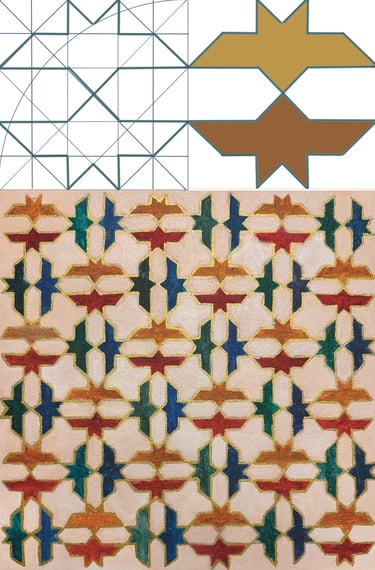
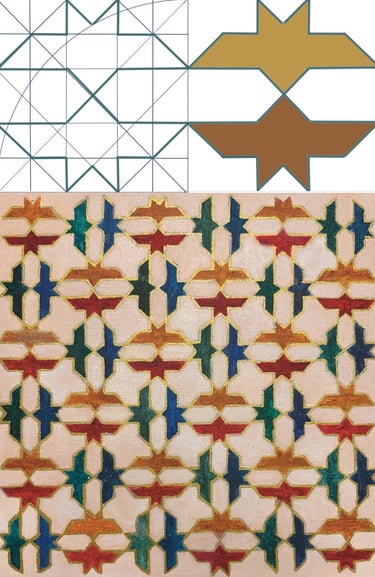
One of forms of art that deeply inspires me is geometric Islamic art — especially Moroccan, Moorish, and Persian traditions. These patterns begin with extraordinary precision, constructed with ruler and compass so every element connects seamlessly in perfect mathematical harmony. Artisans first create highly accurate geometric designs and templates that can then be transferred onto stone, wood, plaster, or glass. Yet once the work enters the hands of craftsmen — carved into walls, assembled into mosaics, or shaped from colored stone — absolute perfection naturally gives way to subtle variation. In Alhambra-style mosaics, for example, each small piece is chiseled from differently colored tiles. No two tiles are exactly alike. The patterns remain mathematically continuous, but tiny shifts in color, texture, and hand-cut form bring warmth and life to the design.
This is what transforms geometry into art. Precision creates the foundation, but human variation gives it soul. Between exact structure and imperfect execution, something breathtaking emerges — a beauty that could never exist through mechanical perfection alone. One of the artistic lessons I learned in childhood was never to reach for a ruler to draw a long “perfectly straight” line — especially for something like a horizon. The moment a line becomes mechanically perfect, it can lose its life. In nature, nothing is truly geometrically perfect. Even light itself does not travel in absolutely straight lines. A horizon breathes through subtle movement, tiny irregularities, and the sensitivity of the human hand.
I came to understand that perfection in art is not the absence of imperfection. True beauty often lives in the delicate space between order and variation — where precision provides structure, but human touch gives the work its vitality and soul and perfect imperfection is born.